


Whole-home rewiring means replacing a house’s old branch-circuit wiring with new, grounded copper cable, usually because the existing system is knob-and-tube or aluminum wiring. It is worth considering when wiring is damaged or ungrounded, when insurers object, or when you are renovating anyway. A licensed electrician should inspect first, because a targeted repair is sometimes enough.
This guide covers how to recognize the two wiring types most often behind a rewire, what the U.S. Consumer Product Safety Commission (CPSC) recommends, and how the job and permits work. For choosing the contractor, start with our main guide on how to hire an electrician.
What is knob-and-tube wiring and is it dangerous?
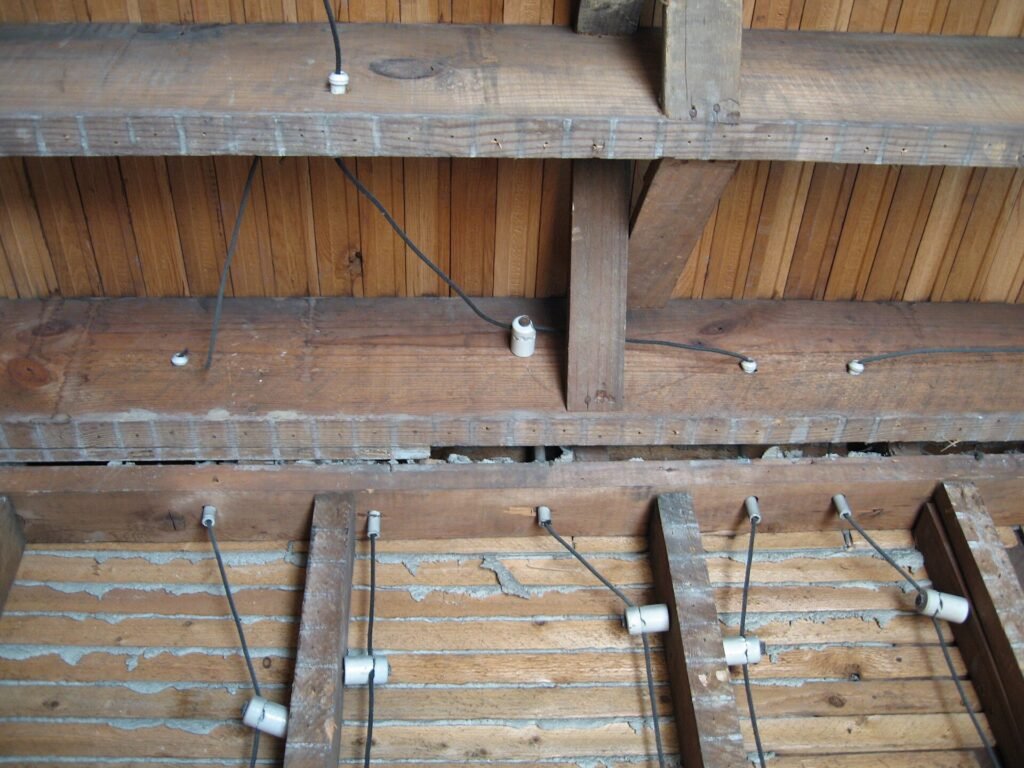
Knob-and-tube wiring is an early electrical method used in homes built in the early 20th century. Single insulated wires run through the framing, held off the wood by porcelain knobs and passed through joists in porcelain tubes. You can often see it in unfinished attics and basements.
Undisturbed knob-and-tube in good condition is not automatically a fire, but it has real limits:
- No ground wire. It cannot provide a grounded outlet for modern electronics or appliances without new wiring.
- It must not be buried in insulation. The National Electrical Code (Article 394) does not permit concealed knob-and-tube in hollow walls, ceilings, or attics where insulation surrounds the conductors, because the wires rely on open air to shed heat. A U.S. Department of Energy weatherization job aid tells crews to check for live knob-and-tube and dam it off or replace it with modern wiring before insulating an attic floor.
- Age and alterations. After a century, insulation on the wire can be brittle, and later owners often spliced newer cable into it or put in larger fuses than the wire can safely carry.
If you plan to add attic or wall insulation to an older house, deal with any live knob-and-tube first. That single project is one of the most common reasons homeowners end up rewiring.
What is aluminum branch wiring and why does CPSC warn about it?
According to CPSC Publication 516, Repairing Aluminum Wiring, a copper shortage in the mid-1960s led builders to use aluminum for ordinary 15- and 20-amp household circuits. Homes built before 1965 are unlikely to have it, while cable installed between 1965 and the mid-1970s, in new homes, additions, or rewired circuits, may contain it.
The problem is at the connections. A national survey for CPSC found that homes built before 1972 and wired with aluminum were 55 times more likely than copper-wired homes to have one or more outlet connections reach “fire hazard conditions.” Deterioration at switches, outlets, splices, and appliance connections raises resistance and causes overheating.
How can you tell if you have aluminum wiring?
CPSC says to read the printing on the cable jacket in the basement, attic, or garage. Aluminum cable is marked “AL” or “Aluminum” every few feet. If the jacket also says “CU-clad” or “Copper-clad,” it is copper-coated aluminum, which is not covered by CPSC’s repair guidance. If you cannot read the markings, have an electrician check.
What repairs does CPSC accept?
CPSC approves only three methods as a permanent repair for aluminum branch wiring:
- Complete replacement with copper. CPSC calls this the best method, though it can be impractical or costly in some homes.
- COPALUM crimp connectors. A short copper wire (pigtail) is attached to each aluminum wire with a special crimp, at every outlet, switch, fixture, appliance, and junction box.
- AlumiConn connectors. An alternative pigtail method using a set-screw connector, recommended by CPSC when COPALUM is not available.
This guidance applies to small branch circuits. CPSC notes it does not cover the larger aluminum conductors used for service entrance cables, ranges, and dryers, which are still common and handled differently.
What are the warning signs your wiring needs attention?
CPSC warns that failing aluminum connections often give no warning at all before they overheat. When there are signs, they overlap with other wiring problems. Call a licensed electrician if you notice:
- Switch or outlet cover plates that feel warm or hot
- Flickering or dimming lights
- Circuits or outlets that stop working
- A burning-plastic smell near outlets or switches
- Fuses that blow or breakers that trip often
- Mostly two-prong, ungrounded outlets throughout the house
Our article on signs you need an electrician covers more symptoms and which ones are urgent.
Do not try to repair aluminum or knob-and-tube connections yourself. CPSC specifically warns that you could be electrocuted or make the problem worse. Standard twist-on connectors and ordinary devices are not a substitute for the approved repair methods.
Will old wiring affect your homeowners insurance?
It can. Progressive, for example, says some insurers may not offer a policy on a home with knob-and-tube or aluminum wiring, and those that do may charge a higher premium because of the fire risk. Insurers may also ask for an electrician’s inspection report on the wiring’s condition before writing coverage.
If you are buying an older home, ask your insurance agent about the wiring before the inspection period ends. A written evaluation from a licensed electrician, and later the permit sign-off for any rewiring, are the documents insurers usually want to see.
Partial rewire or whole-home rewiring: which do you need?
Not every older home needs every wire replaced. An electrician’s inspection should tell you what is actually installed, what condition it is in, and what the options are.
| Approach | When it fits | Trade-offs |
|---|---|---|
| Targeted repair (e.g. COPALUM or AlumiConn pigtails) | Aluminum branch wiring in otherwise sound condition | Keeps existing wire; every connection in the house must be done |
| Partial rewire | Live knob-and-tube in a few areas, or a kitchen, bath, or addition being remodeled | Lower disruption now; the rest of the old wiring remains |
| Full rewire | Widespread knob-and-tube, damaged or heavily altered wiring, or insurer requirements | Most disruption and cost; brings grounding and circuits up to current code |
A rewire is also a good time to review the service and panel. Old fuse boxes and undersized services are often replaced at the same time, especially when new circuits are being added for a remodeled kitchen or central air.
How does the rewiring process work?
- Inspection and scope. The electrician maps circuits, identifies wiring types, and writes a scope listing which circuits will be replaced and where new outlets go.
- Permit. The contractor applies for an electrical permit before work starts.
- Rough-in. New cable is fished through walls and ceilings, often through small access holes, attics, and basements. Old wiring is disconnected and abandoned in place or removed where accessible.
- Rough-in inspection. The inspector checks the new wiring before walls are closed.
- Patching and finish. Wall openings are repaired (confirm whether the electrician or a separate drywall or plaster contractor does this), then devices and fixtures are installed.
- Final inspection. The inspector signs off, and you keep the permit record for insurance and resale.
New circuits must meet the code your jurisdiction currently enforces, which can include grounding, arc-fault, and ground-fault protection in specific rooms. Our guide to electrical permits and inspections explains what inspectors look for at each stage.
Plaster walls, finished basements, and occupied homes all affect how long a rewire takes. Ask for a written schedule that shows which rooms will be without power and for how long.
What should a rewiring quote include?
Rewiring bids are hard to compare unless they describe the same work. Ask every contractor to put the following in writing:
- Which circuits and rooms will be rewired, and which existing wiring will remain
- The number and location of new outlets, switches, and dedicated circuits
- Whether the panel or service is included, or priced separately
- Who patches plaster or drywall and who paints, since many electricians only cut and close access holes
- The permit, the inspections included, and how long the project will take
- For aluminum wiring repairs, which approved method and connector will be used at every connection
A detailed scope protects you if the job uncovers surprises, such as hidden splices or damaged framing, because changes can be priced against the original plan.
How do you find an electrician for a rewire?
Rewiring older homes takes experience with plaster, old framing, and the approved aluminum repair methods, so ask bidders how many similar jobs they have done and whether they are trained on COPALUM or AlumiConn. Compare licensed electricians on your state’s top list (see how we rank electricians), or get 3 free quotes and compare written scopes side by side.

Comments
Write a commentNo comments yet. Ask a question or share how your project went.